
 Improve Performance
 Fix Problems
 Learn
Learn Audit
Audit Case Studies
 Guides
 Blog
Blog Last Updated July 28, 2026


AI Max (formerly Search Max) is a feature for Google Search Ads campaigns that offers search term matching along with text and URL optimization. Here’s what the experts want you to know about this future-minded setting.
In summer 2025, eagle-eyed marketing pros spotted a new Google Ads feature the team was ostensibly beta testing: AI Max. In May 2025, brand exclusions began upgrading into AI Max for Search campaigns.
When the option began appearing on selected match-type reports, people started asking questions (leave it to marketers, we’re a nosey bunch).
Now, as this feature continues to roll out into more accounts after launching a year ago, we wanted to know more and then share our findings.
We asked Google Ads expert and HawkSEM Director of Account Performance Jessica Weber for her take on Google AI Max.
Read on for what she had to say, how to implement this feature, and what it means for the future of digital advertising.

Search term matching uses Performance Max (PMax), Broad Match, Dynamic Search Ads (DSAs), and AI to expand your campaigns’ reach. (Image: jakkapan/Adobe)
What is AI Max?
AI Max is a paid search campaign feature that offers search term matching as well as text and URL optimization.
In thinking outside the traditional “demand gen” and “exact match” boxes, AI Max leverages Google’s AI and automation tools to enhance both performance and transparency when it comes to pay-per-click (PPC) campaigns on the Google platform.
Is your head spinning yet? Let’s break it down.
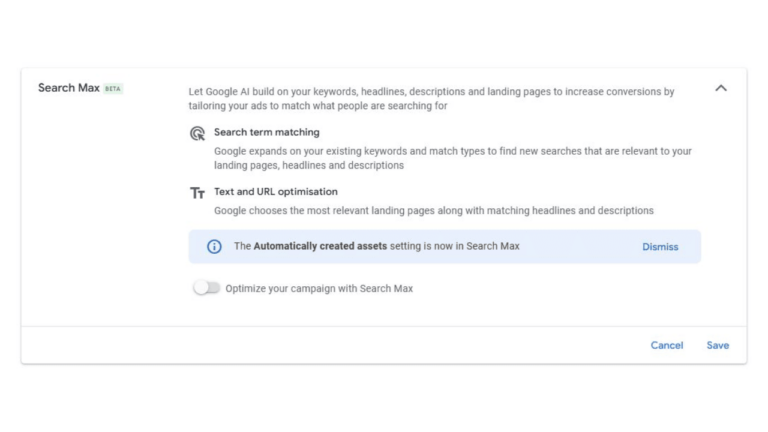
Search term matching uses Performance Max (PMax), Broad Match, Dynamic Search Ads (DSAs), and AI to expand your campaigns’ reach.
Text and URL optimization surfaces the most “performant URLs” for a search query, and leverages automation for more relevant and better-performing descriptions, asset optimization, and overall ad creation.
“AI Max is more of a campaign type with customized settings now,” says Weber.
Since its expanded rollout in late 2025, Google has positioned AI Max as the next era of Search campaigns, combining elements of Broad Match, Dynamic Search Ads (DSAs), Responsive Search Ads (RSAs), and Performance Max while maintaining core Search campaign elements.
“I like to think of it as a mix of DSA gone wild with PMax minus display and video with URL expansion on,” she adds.
Essentially, you’re relinquishing targeting and control to Google’s machine learning when it comes to where users are sent.
Google lays out five core benefits it sees of AI Max, which are:
- Better reach via expanded keywords to Broad Match keywords and keywordless matching to increase targeting opportunities
- Increased campaign performance through more conversions
- A cutting-edge marketing strategy that has AI and the future in mind
- More efficiency through automations and easy ad updates
- Enhanced transparency via deeper reporting insights and data
Google itself has reported that “advertisers that activate AI Max in Search campaigns will typically see 14% more conversions or conversion value at a similar CPA/ROAS.”
AI Max now also leverages final URL expansion, or FUE, by using machine learning to automatically route users to the most relevant page on your site based on perceived search intent.
To ensure the best possible results from FUE, we recommend reviewing site elements like thank-you pages, support pages, careers pages, blog content, and outdated URLs to ensure searchers end up where they need to be.
The evolution of AI Max
During an industry Q&A chat with digital marketing expert Julie Friedman Bacchini and Google Ads Product Liaison Ginny Marvin in 2025, it was mentioned that AI Max would start rolling out globally at the end of that May.
“The keywordless technology in AI Max for Search campaigns enables targeting based on the information on your landing page, similar to Dynamic Search Ads, as well as targeting based on the assets in the ad group,” said Marvin.
With a year of AI Max behind us, Google has recently announced its plans for new ways to steer performance and expand to more advertisers.
Some highlights mentioned in the search engine’s retrospective report include:
- Leveraging AI Max to streamline and enhance travel and shopping campaigns
- Using AI Brief to help Gemini better understand your business, offerings, and audience
- Taking advantage of asset optimization settings to capitalize on natural language queries
- Enabling Final URL Expansion, but only if confident in your website’s content optimization
- Using text customization to automatically create ad assets to match query and landing page in the moment
Pro tip: Google has noted that negative keywords are essential for keeping your AI Max campaigns “focused and brand-safe.” Because AI Max relies heavily on broad matching, negatives prevent the algorithm from chasing what Google calls irrelevant, wasteful, or off-brand search queries.
More automation, less control
More automation usually means less control. Because of this, it will be crucial to continue closely monitoring performance as well as how Google inevitably updates or modifies AI Max to maintain the proper brand control.
However, Weber believes that this has the potential to be a powerhouse for scaling, especially with high product volume or SKU count ecommerce brands, as it enables AI customization capabilities for all products without long timelines for segmented builds.
“Being an early adopter of new Google products has worked out well for our clients,” she adds. “Very early PMax was a good time. I look at this situation no differently.”
Enhanced reporting
Unsurprisingly, with the rollout of AI Max comes changes to reporting so you can continue to track your campaign’s performance. Here’s how Google breaks it down:
- The Search Terms report includes “AI Max” as a new match type.
- There’s a view that shows the combined search term, headlines and URLs for a fuller picture of the buyer’s journey.
- Keywords report: Summary rows in the keywords report now show “AI Max” to view total AI Max contributions.
- The landing pages report has a “Selected by” column that shows performance of AI Max on landing pages.
- The asset report now also shows the performance of AI Max assets.
(Image: Google Ads screenshot)
Pro tip: Google has clarified that activating or deactivating AI Max “may cause errors for API requests managing text customizations and brand settings in your campaign, as AI Max is not yet available in the API and Editor.” They suggest informing your team before proceeding with either of these actions.
How to determine if AI Max is right for you
When thinking about implementing AI Max, Weber recommends asking yourself if you think Google truly understands your business: what you offer, and who its products or services are for.
If you aren’t sure, she suggests maybe avoiding this setting for now and working on providing Google the data it needs to figure you out instead.
Your success with this product, just like any other AI-led product, will depend on factors like:
- Your strategy
- How your campaigns are set up
- How well your website content is optimized
- The data quality and volume you are sharing with Google
- Your conversion goals vs. actual business impact
Odds are, you will not be successful with this campaign type if you’re not communicating who a customer is or what you deem to be valuable conversion actions (this does not mean phone calls and form fills), if you have low conversion volume, or if your conversion tracking isn’t properly set up.
Weber recommends giving AI Max a test if you meet these two requirements:
- You’re importing purchases, new customers, or qualified leads into your Google Ads account daily via automated methods, not static Google Sheets
- You have a volume of over 30 conversions per 30-day period for your primary conversion action
How to implement AI Max
AI Max can be activated when creating a new Search campaign. You should see that your search campaigns now have an “AI Max” toggle option.
From there, you’ll go to AI Max in your Google Ads campaign settings, then toggle the option to opt in to the AI Max settings.
You can also add a URL exclusion or page feeds if there’s a URL or ad you don’t want to serve or a specific set of pages you want to use for the campaign.
AI Max and the future of paid search
“I think we’re seeing the beginning of the end of keyword targeting,” says Weber.
“We are moving into intent-based and contextual search, [just like] the golden days of marketing. It will be a little more complicated since machine learning and algorithms were not around with traditional advertising.”
While getting the right creative and ad copy in front of people who look and act like your customers is a powerful combination, she suggests utilizing real-time data-driven AI decision-making by Google to take things to the next level and get ahead of the changes coming.
These days, it seems the biggest concern among advertisers isn’t only whether AI Max works, but also whether enough guidelines exist to ensure traffic quality and brand safety.
As a result, Google has introduced more controls and reporting features that weren’t available during the original 2025 rollout.
The takeaway
It’s fair to say that AI Max has had some marketers worried about too much automation.
However, those who have been in the game for a decade or more know that automated solutions simply can’t match the experience and attention to detail that comes from a real-deal marketing human.
“Don’t be afraid of new products or changes to the platform,” Weber suggests, “but ensure your account ecosystem and website is ready for it first.”
She recommends making sure that you’ve gone through the Google Ads AI Essentials and gotten your account set up to send the information to Google that its AI algorithm needs.
And if you aren’t sure how to do this? Partner with the right team to ensure your digital marketing, from paid search management and social media marketing to SEO to AI Visibility and everything in between, is future-minded and set up for success.
We’d love to partner with your brand to explore this exciting new frontier of Google Ads. Let’s connect.
This article has been updated and was originally published in June 2025.