
 Improve Performance
 Fix Problems
 Learn
Learn Audit
Audit Case Studies
 Guides
 Blog
Blog Last Updated May 26, 2026


A content marketing funnel guides prospective customers from awareness to purchase using relevant content and distribution channels at every stage of the journey. Learn how to build a funnel to drive traffic and conversions for your site.
Content marketing has the power to help people discover your business, become interested in your product or service, and become loyal customers.
But that’s only possible when your content is strategically mapped to the customer journey — which is where a content marketing funnel comes in.
In this article, we’ll break down what a content marketing funnel is and how you can build one that works.
What is a content marketing funnel?
A content marketing funnel is a strategy that maps content to each stage of the customer journey.
Every stage represents a different level of interest — and a different type of content designed to guide the user toward the next step and, ultimately, a conversion.
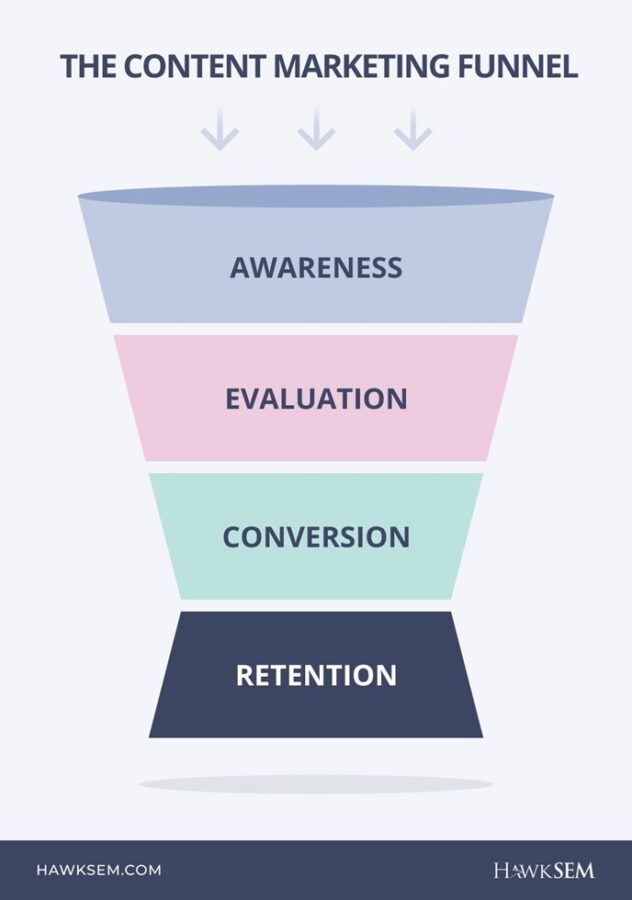
Stages of the content marketing funnel
There are three different stages of the content marketing funnel:
- Top of the funnel or TOFU (awareness/discovery)
- Middle of the funnel or MOFU (consideration/interest)
- Bottom of the funnel or BOFU (conversion/decision)
TOFU brings people in, MOFU builds trust, and BOFU drives conversions.
It’s also considered best practice to incorporate a fourth stage: beyond the funnel (retention).
Top of the funnel (TOFU) content
The top of the funnel is where you’ll create content that attracts attention. Top-of-funnel content should be free, accessible, searchable, and discoverable online to nurture the awareness stage.
TOFU content types include:
- Blogs and articles: How-to guides, listicles, and educational articles.
- Podcasts: A branded audio series released in recurring episodes, or guest appearances on other relevant podcasts, to share educational content related to your business.
- Infographics: Visual explanation of data or information designed to be easily digestible and shared in articles, email marketing, or social media posts.
- Educational videos: How-to videos, interviews, or behind-the-scenes videos shared on YouTube, Instagram, or TikTok.
- Social media content: Short-form content published across social platforms to build brand awareness, engage audiences, and drive traffic.
Middle of the funnel (MOFU) content
The middle of the content marketing funnel focuses on prospects who are showing signs of interest. MOFU content should showcase why your solution is the best to nurture the consideration stage.
The most effective middle-of-funnel content formats include:
-
- Blogs and articles: Tutorials, comparison articles, and comprehensive guides.
- Webinars: An educational virtual seminar that lasts 30-60 minutes and explains a topic relevant to your business or industry.
- Tutorial videos: In-depth videos that showcase how your product, software, or service works.
- Reports and original research: In-depth, data-driven content based on proprietary research or industry surveys that offers unique insights readers can’t find elsewhere.
- Newsletters: Regular emails that nurture subscribers with valuable content, insights, and resources to keep your brand top of mind.
- Case studies: Success stories your company had with past customers and clients to help prospects assess your credibility and build trust.
- Quizzes: An interactive assessment that asks users a series of questions to deliver a personalized result or recommendation.
- Templates: Pre-built, customizable resources designed for prospects to use for free, typically gated behind a lead capture form.
- Free tools: Interactive, web-based resources that let users accomplish a specific task for free, typically gated behind a lead capture form.
- Ebooks: A long-form, downloadable guide that explores a topic in depth, typically gated.
- Blogs and articles: Tutorials, comparison articles, and comprehensive guides.
Bottom of the funnel (BOFU) content
Bottom funnel content is where you’ll attempt to convert potential customers or clients.
Bottom-of-funnel content centers around getting potential customers to convert in the decision stage through:
-
-
- Landing pages: A standalone web page designed to drive a specific action, like signing up, downloading, or making a purchase.
- Service and product pages: Web pages that outline the features and benefits of a specific product or service.
- FAQs: Pages that address common objections or hesitations before people convert.
- Pricing pages: Web pages dedicated to outlining a product or service’s costs, plans, and features to help prospects make a purchase decision.
- Demos: A personalized, one-on-one walkthrough of a product or service designed to help prospects determine if it’s the right fit before committing.
- White papers: Authoritative, data-driven reports that provide the in-depth technical analysis and proof points decision-makers need to justify a purchase.
- Email content: Personalized, conversion-focused messages sent to warm leads to drive a specific action like a purchase, sign-up, or demo request.
- Case studies: Real-world examples of how a product or service helped a customer achieve specific, measurable results.
- Testimonials and reviews: Quotes, ratings, and reviews from satisfied customers that reinforce trust and validate the purchase decision.
- Comparison pages: Blog content, landing pages, or webpages that break down your products, services, or your brand against competitors side-by-side to help prospects evaluate their purchasing choices.
- Free trials: Limited access to a product that lets prospects experience value before committing to a purchase.
-
Beyond the funnel: Retention
Keeping an existing customer is significantly cheaper than acquiring a new one.
After nurturing a customer through the entire sales funnel, the goal of your content shifts from conversion to ongoing value.
This means content should make customers feel supported, informed, and rewarded for their loyalty.
This content can also turn customers or clients into advocates who send along referrals.
Effective content types for retention include:
-
-
- Email newsletters: Personalized emails that share helpful tips, insider discounts, first-to-know information, and product updates.
- Tutorial videos: Videos that help existing customers get the most out of your product or service.
- Community and forums: Online spaces where customers can connect, share experiences, ask questions, and engage directly with your brand.
- Loyalty programs: Incentive-based programs that reward repeat customers with discounts, perks, or exclusive access to new products and features.
-
How to implement a content marketing funnel
Building an effective content marketing funnel involves audience research to identify the right types of content for your brand.
1. Research your target audience
Before creating a single piece of content, you need to understand who your audience is and what different types of content they want.
“Knowing your target audience like the back of your hand is essential when creating a strategy for a content funnel,” says co-founder and president of HawkSEM Rambod Yadegar.
“Without it, you cannot create valuable content for the reader, which will adversely affect the performance of your content marketing campaigns.”
There are a few ways to research your target audience:
-
-
- Social media and website analytics: If your business and online presence has been around for a while, use Google Analytics to get an idea of the demographics of the people following you and visiting your website.
- Create a buyer persona: Put together a profile based on your target customer and the people/businesses who are most likely to need your product or service.
- Market research: Conduct surveys and interviews with a wide range of people to confirm which ones are most likely to need your business and what their demographics, interests, and overall purchasing behavior is.
- Analyze competitor audiences: Make sure your audience aligns well with your competitors’ audiences. While your audiences may not fully overlap, there likely will be a number of similarities.
-
Beyond knowing your target audience, you also need to know how they’ll behave throughout each stage of the sales funnel.
This can help you decide exactly which types of content to create in order to maximize conversions.
Think about it like this: if you’re targeting Gen Z or Millennials, their buying journey will look different from Gen X or Baby Boomers. They use different technology and view technology in different ways.
2. Map content types to each stage of the funnel
Once you have a clear picture of your target audience, you can identify the types of content that best support their journey from awareness to conversion.
Make sure your content marketing funnel has a healthy mix of TOFU, MOFU, and BOFU content — gaps at any stage can cause prospects to drop off.
A useful approach is to organize content around topic clusters:
-
-
- Identify core themes relevant to your brand
- Break them into supporting subtopics
- Ensure each cluster is represented across TOFU, MOFU, and BOFU content
-
This ensures you’re not just creating content randomly and instead building guided pathways that move users toward conversion.
3. Assign keywords
Once your structure is in place, assign keywords based on search intent and funnel stage.
-
-
- TOFU keywords tend to be broad and informational
- MOFU keywords indicate consideration
- BOFU keywords signal purchase intent
-
For example, a running shoe brand might target “how to build muscle” (TOFU), “best protein powder for beginners” (MOFU), and “buy whey protein online” (BOFU) — the intent shifts from curiosity to comparison to commitment.
Review existing content to identify gaps, then map new and existing keywords to ensure full funnel coverage.
4. Build a content calendar
A content calendar is the documented plan of when you will write, publish, and promote your content. It keeps production on track, ensures balanced coverage across funnel stages, and helps coordinate distribution across channels.
You can create content calendars on spreadsheets (like Excel or Google Sheets), content marketing applications (like HubSpot), or your project management software (like Asana).
Further reading: What Is a Content Calendar? (+ How to Create One)
5. Create, distribute, and automate
Create high-quality content according to your content plan, then distribute it across relevant channels.
Where possible, use automation tools to streamline publishing, email nurturing, and content distribution so your funnel works continuously in the background.
6. Measure and optimize
Track performance using relevant metrics for each stage of the funnel.
-
-
- TOFU: Impressions, organic traffic, reach
- MOFU: Engagement, time on page, email signups, downloads
- BOFU: Conversion rate, leads, sales, attributed revenue
-
Review performance regularly to identify where content is most successful and where prospects are dropping off.
Why is a content marketing funnel important?
A content marketing funnel helps you reach your target audience throughout the buyer’s journey — guiding them to the next stage by providing helpful content and answers to their questions, concerns, or pain points.
“Using a content marketing funnel transformed our approach, allowing us to create more targeted and effective content,” says Kate Ross, SEO Specialist at Irresistible Me.
“It helped us move beyond just attracting visitors to our site, focusing on nurturing those visitors through their decision-making process.”
A content marketing funnel can provide several benefits to your business:
-
-
- Mapping your customer journey
- Helping people learn more about your business
- Improving sales and retention
- Increasing website traffic
- More brand visibility and share of voice
- Increasing lead generation and nurturing
-
Language learning app Ling saw its own success story by creating a blog as its top-of-the-funnel content marketing strategy.
Co-founder Simon Bacher shares, “We optimize each blog title with a ‘power word’ and a focus keyword included based on our in-depth keyword research. Google’s ‘People Always Ask’ and ‘Related Searches’ help us determine what users want in the content or the search intent.”
This funnel-based content marketing strategy resulted in:
-
-
- 282 pages ranking #1 on Google
- 489% increase in monthly active users (MAU)
- 454% increase in sessions
-
The takeaway
With the right content marketing funnel strategy, you can turn prospects into paying customers.
But the process of developing your own content marketing funnel — from identifying your audience persona to keyword mapping to content creation — is often best left to the professionals.
If you don’t have the time to develop a strategy and want fast results, consider working with the digital marketing experts at HawkSEM.
Reach out today for a free consultation and to learn how we can amplify your marketing efforts.
This article has been updated and was originally published in July 2024.