
 Improve Performance
 Fix Problems
 Learn
Learn Audit
Audit Case Studies
 Guides
 Blog
Blog Last Updated May 7, 2026


Successful Google Ads typically include a clear value proposition, benefit-oriented copy, and a strong CTA. Use these Google Ads examples and pro tips to ensure yours stand out from the rest.
Looking for inspiration to create high-performing pay-per-click (PPC) ads?
These Google Ads examples show real campaigns across search, display, and shopping — plus what makes them effective and how to apply the same tactics to your own ads.
Plus, we gathered expert insights from Rachel Corak, associate director of search engine marketing at HawkSEM to break down what makes an ad successful (or forgettable).
8 Google Ads examples
Through our years of experience of working with clients and building effective Google Ads campaigns, we gathered some of the best examples of Google Ads.
Google search ad examples
Google search ads appear at the top of results for high-intent queries, often blending in with other organic listings.
People trust Google to provide high-quality, authoritative content, so whatever appears at the top of the search engine results page (SERP) is the most likely to get clicked.
Here are two examples of high-performing Google Search ads and why they work.
1. Bright + Early
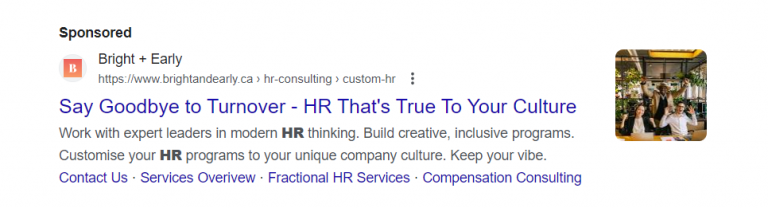
HR consultancy Bright + Early leads with a headline that speaks to one of its audience’s pain points: turnover.
Why this ad works:
- Strong intent match: Targets businesses actively looking for HR solutions to reduce turnover
- Clear value proposition: “Say Goodbye to Turnover – HR That’s True To Your Culture” communicates outcome and differentiation
- Audience relevance: Emphasizes customized HR programs, which appeals to companies seeking tailored solutions
- Appeals to modern HR thinking: Building creative, inclusive programs
- Benefit-oriented language: Focuses on positive outcomes and solutions
- Concise and engaging: Captures attention with short, impactful sentences
- Implicit call-to-action: Encourages the audience to learn more by clicking the ad
- Effective use of assets (formerly ad extensions): Including image and sitelink extensions
How to apply this to your ads:
- Lead with your audience’s biggest pain point (not your service)
- Pair it with a specific, outcome-driven promise
- Reinforce differentiation in the headline (e.g., “custom,” “for your industry,” “proven system”)
- Use ad assets to take up more real estate on the SERP, offer additional information, and offer multiple entry points
2. ClickUp
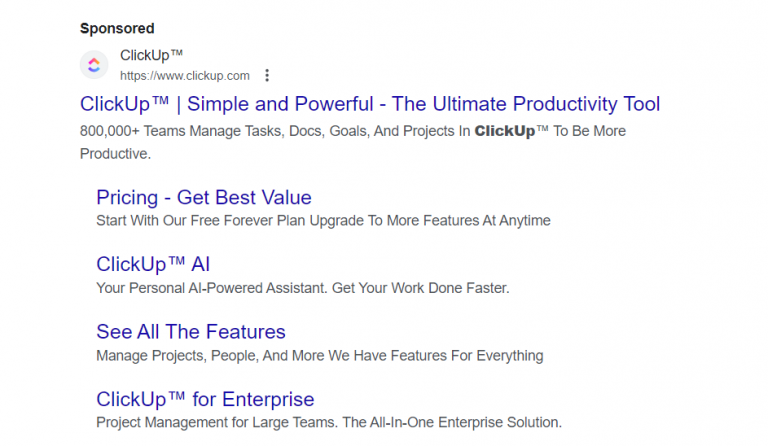
Project management platform ClickUp positions itself as an all-in-one productivity solution, using its text ad to highlight both a variety of features and accessibility (including a free plan).
Why this ad works:
- Strong intent alignment: Targets users searching for productivity or project management tools
- Clear positioning: “Simple and Powerful – The Ultimate Productivity Tool” communicates what it is and why it matters quickly
- Reinforced branding: Repeat the brand name “ClickUp” to build recognition and trust
- Social proof: “800,000+ Teams” signals credibility and trustworthiness
- Low-friction entry point: Mentioning the “Free Forever Plan” in the ad attracts users who want to try the product before committing
- Feature highlights: Highlights multiple use cases (tasks, docs, goals, projects) to appeal to a broad audience
- Trend alignment: Mentions AI-powered assistance to tap into current demand and differentiate
- Scalable appeal: The ad positions the product as suitable for both individual users and large organizations
- Call-to-action: The ad includes a clear CTA by encouraging users to “See All The Features”
How to apply this to your ads:
- Use social proof or numbers to build instant credibility
- Reduce friction with a free trial, demo, or entry-level offer
- Highlight multiple use cases if your product serves different audiences
- Use sitelinks to guide users to high-intent pages (features, pricing, demos)
Display ads examples
Display ads appear on websites within the Google Display Network (GDN), helping brands reach users as they browse content, not just when they’re actively searching.
Because of this, effective display ads rely on strong visuals, clear messaging, and quick value communication to capture attention.
Here are two examples of display ads that get it right.
3. MongoDB Atlas
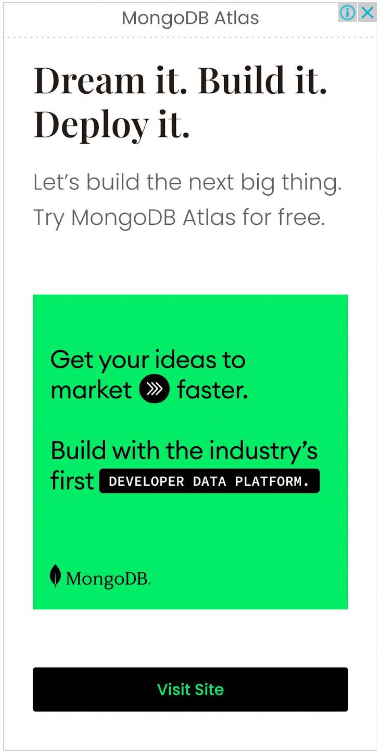
MongoDB Atlas uses bold color and concise messaging to stand out, pairing a strong visual (bright green) with a clear, benefit-driven promise: “Get your ideas to market faster.”
Why this ad works:
- Attention-grabbing design: High-contrast color helps the ad stand out in a crowded page environment
- Clear and aspirational messaging: Starts with a simple and aspirational message, “Dream it. Build it. Deploy it. Let’s build the next big thing”
- Clear value proposition: Emphasizes speed and efficiency — key priorities for developers
- Targeted audience: “Developer data platform” signals exactly who the product is for
- Concise copy: Short, punchy phrases make the message easy to absorb quickly
- Strong CTA: “Try MongoDB Atlas for free” reduces friction and encourages action
How to apply this to your ads:
- Use bold visuals or contrast to stand out from surrounding content
- Lead with a single, clear benefit (speed, cost, ease, etc.)
- Keep copy minimal and scannable
- Call out your target audience directly when possible
- Pair with a low-commitment CTA (free trial, demo, etc.)
4. GoDaddy
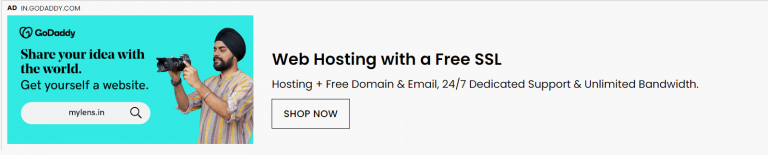
GoDaddy takes a more straightforward approach, using simple messaging and strong offers to appeal to a broad audience looking to build a website.
Why this ad works:
- Clear and direct messaging: Delivers a clear and direct message, encouraging users to “Share your idea with the world” and “Get yourself a website”
- Broad appeal: Speaks to anyone looking to create a website, from individuals to small businesses
- Personalization element: Featuring a sample domain name, “mylens.in,” which adds a personalized touch
- Benefit-oriented offer: “Free SSL,” “Free Domain & Email,” “24/7 Dedicated Support,” and “Unlimited Bandwidth”
- Urgency: Includes the phrase “SHOP NOW,” which adds a sense of urgency and encourages users to act promptly — urgency can be an effective motivator for increasing click-through rates (CTRs)
- Visual simplicity: Keeps the focus on the offer rather than overcomplicating the design
How to apply this to your ads:
- Lead with a clear outcome your audience wants (launch a site, grow a business, etc.)
- Highlight specific offers or incentives to increase clicks
- Use simple visuals that support the message (without distracting)
- Add urgency with CTAs like “Get started,” “Try free,” or “Shop now”
YouTube video ad examples
YouTube ads appear before, during, or after organic videos, giving brands a chance to capture attention in a highly engaging format. Because viewers can often skip after a few seconds, the most effective video ads hook attention quickly, demonstrate value fast, and make the next step clear.
Here are two YouTube ads that do it well.
5. Grammarly Business
Grammarly takes a product-led approach, using its video ad to demonstrate how its “Knowledge Share” feature solves a specific business challenge: information silos.
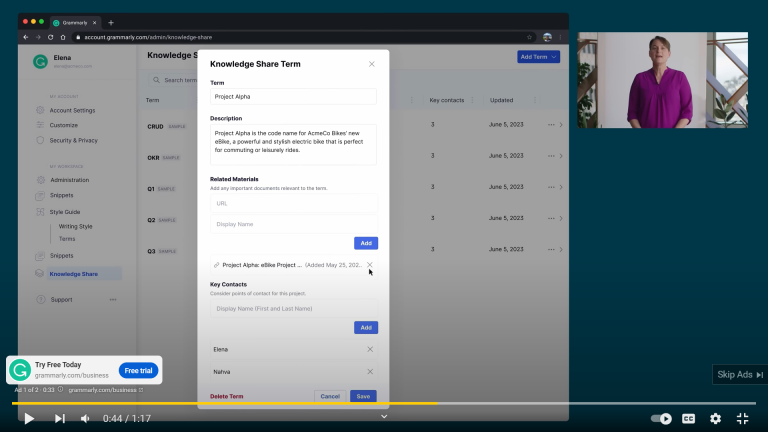
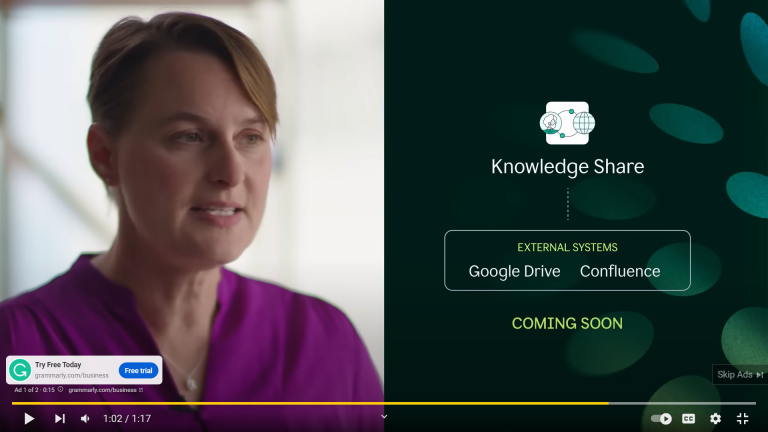
Why this ad works:
- Strong, specific pain point: Focuses on a clear problem (disconnected knowledge across teams), not just generic writing improvement
- Human touch: Rather than relying on text on the screen or a voiceover, it features a woman throughout the ad, guiding viewers through the new feature and its benefits (another product-led approach)
- Real-life example: Showcasing a real-life example of how the feature will function and add value, so viewers can envision themselves using (and benefiting from) it
- Engaging visuals: Combines UI shots with motion graphics to keep attention
- Clear value: Emphasizes efficiency and collaboration — key priorities for business users
How to apply this to your ads:
- Lead with a specific, high-impact pain point
- Show your product solving that problem
- Use a human or narrative to make the ad more relatable
- Focus on a single feature and outcome to avoid overwhelming viewers
6. Adobe
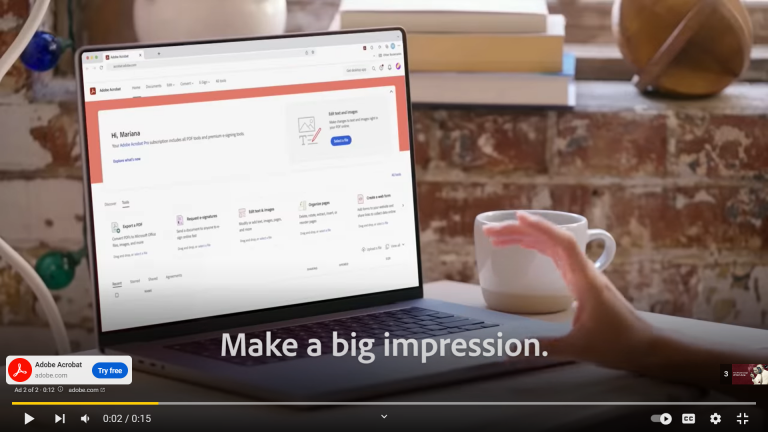
Adobe uses a more subtle, lifestyle-driven approach — showing someone naturally using its product rather than explicitly selling it.
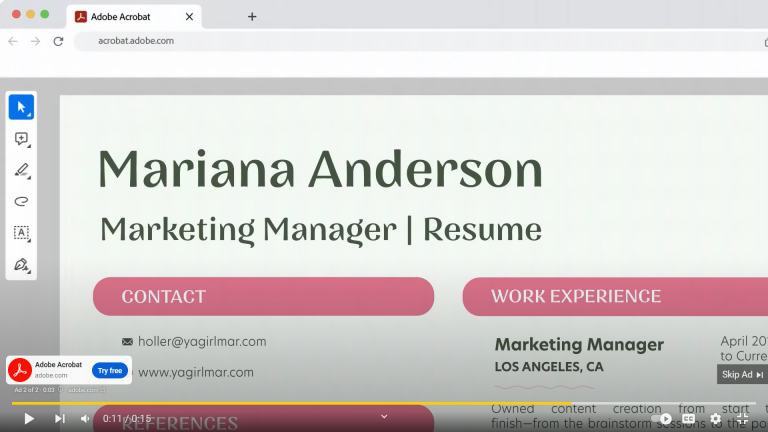
This example works because it feels less sales-y and allows users to envision themselves also using the platform.
Why this ad works:
- Problem-solution clarity: Focuses on helping users create polished, professional documents
- Show, don’t tell: Demonstrates how to convert documents to PDF within the product
- Low-pressure storytelling: Feels less like a sales pitch and more like a real usage scenario
- Built-in tutorial: Acts as a mini how-to, educating while promoting
- Short, efficient format: Delivers value in ~15 seconds—ideal for skippable ads
- Compelling offer: Ends with a free trial, lowering the barrier to entry
How to apply this to your ads:
- Show your product being used in a realistic, everyday scenario
- Teach something quickly (a mini demo or tip)
- Keep videos short and focused — especially for skippable formats
- End with a low-friction CTA (free trial, demo, download)
Shopping ads examples
Google Shopping ads appear at the top of search results for product-based queries, showcasing product images, pricing, discounts, and reviews.
Because users can compare options at a glance, the most effective Shopping ads stand out with strong visuals, competitive pricing, and clear value signals.
Here are two examples of high-performing Shopping ads.
7. Boden
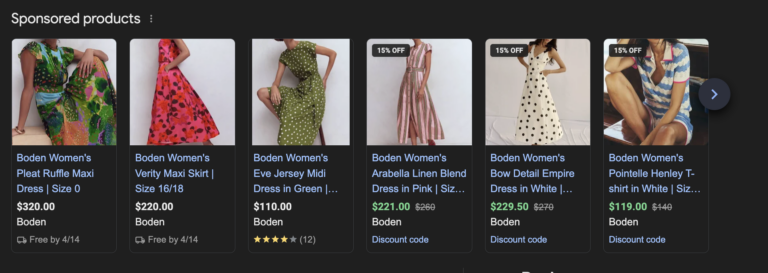
Boden’s Shopping ads stand out by combining vibrant product imagery with clear pricing incentives, making them highly clickable in a crowded results page.
Why this ad works:
- Eye-catching visuals: Bright, colorful product images draw attention while showcasing style and fit
- Discount visibility: The price is highlighted in green with the original price crossed out, as well as a “15% off” label to reinforce urgency
- Trust signals: Free shipping icon (in some variations) reduces friction and increases likelihood to click
- Consistent branding: Cohesive styling across products builds recognition and credibility
How to apply this to your ads:
- Use high-quality, lifestyle product images
- Highlight discounts clearly with price drops and promotional labels
- Include free shipping or incentives when possible
- Keep product data (titles, pricing) clean and easy to scan
8. Athleta
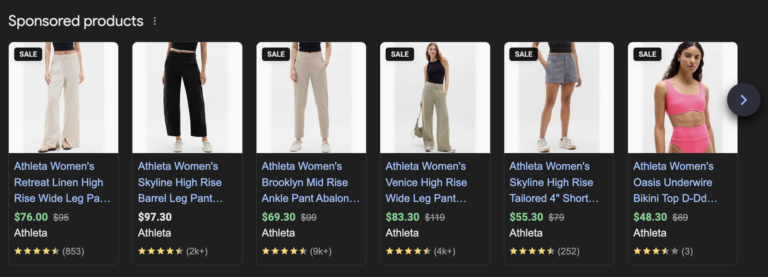
Athleta’s Shopping ads stand out by combining strong product variety with visible social proof, helping shoppers feel confident in their click (and purchase).
Why this ad works:
- Social proof: Star ratings and a high volume of reviews (over 9,000 in one example) build trust
- Clear discounts: Sale prices paired with crossed-out original prices highlight savings
- Product variety: Multiple styles (pants, shorts, swimwear) appear side by side, increasing the chance of relevance
- Consistent visuals: Clean, minimal product images keep the focus on fit and style
How to apply this to your ads:
- Prioritize reviews and ratings to build trust
- Showcase multiple products to increase visibility across branded queries
- Use high-quality, consistent imagery
- Highlight discounts clearly with price comparisons
Expert tips to implement winning strategies
Now that you’ve seen what high-performing Google Ads look like, the next step is applying those strategies to your own campaigns.
Here are a few expert-backed tips to help build more effective Google ads:
Responsive search ad strategy tips
When building and optimizing responsive search ads, efficiency and targeting are key.
“Use Google Ads Editor when building search ads to save time and make edits much more quickly,” says Corak.
Also, avoid wasting money on the wrong ad network. “When launching search campaigns, be sure to look for the setting to disable serving ads on the display network,” Corak recommends.
“This will ensure your ads are serving on the right placement and improve ROI.”
Finally, improve your Quality Score (Google’s rating of your ad relevance and landing page experience). This can lower your cost-per-click and improve ad placement.
Display ad strategy tips
“Display ads can drive a notoriously low ROI,” cautions Corak. But that doesn’t mean you should avoid this campaign type altogether. Instead, take a strategic approach to campaign setup.
“It’s important to focus on audience targeting,” says Corak. “Retargeting audiences, for example, will drive significantly higher returns than cold audiences.”
YouTube ad strategy tips
To succeed with YouTube ads, pay close attention to your Google Ads conversion settings.
“If you are using GA4 conversion actions instead of native gtags, you may not see engaged conversions, view-through conversions, or other conversions reported to video views,” says Corak.
What makes a Google ad stand out?
It’s not enough to create ads, upload them to campaigns, and wait for clicks. It takes careful analysis, campaign optimization, and testing to make ads work.
Here’s what every Google ad should have (across all ad networks) based on Corak’s insights:
- Compelling headlines and CTAs: Clearly communicate value and give users a reason to act
- Utilize assets: Site links, promos, phone number, image, and call extensions help your ad take up more space and drive more clicks
- Strong value signals: Promotions, reviews, and pricing help build trust and encourage conversions
By ad type:
- Search ads: Use headlines with relevant keywords and multiple variations to match intent
- Shopping ads: Optimize your product feed (titles, images, descriptions) and highlight promotions through Google Merchant Center
- Display ads: Use eye-catching visuals, minimal text, and a clear CTA to capture attention quickly
- YouTube ads: Hook viewers early with engaging visuals and reinforce your message with a strong CTA
This isn’t an exhaustive list, but it points you in the right direction to make a killer ad.
Pro tip: Use Performance Max campaigns’ machine learning and automation to improve your ad spend and performance. Leverage its insights to make data-driven decisions to refine your ad creatives and keyword selection.
Common Google Ads mistakes
Some brand owners choose to build and maintain their own PPC ad campaigns, only to find the results are mediocre or non-existent. Usually, it comes down to avoidable missteps.
These are the most common ones, according to Corak:
Creative and ad copy
- Weak ad creatives, CTAs, or copywriting that fail to entice the searcher to click
- Skipping A/B testing to discover what actually converts
- Not building a relevant, conversion-focused landing page with a strong user experience and clear unique selling point
Targeting and segmentation
- Targeting the wrong audiences
- Not segmenting campaigns and ad groups enough to reach highly qualified prospects and potential customers
- Failing to add negative keywords to filter out irrelevant clicks (especially in Shopping campaigns for ecommerce brands)
- Leaving Display Network opted into search campaigns, where user intent is broad
Bidding and strategy
- Using the wrong bidding strategy — for example, Maximize Clicks, which prioritizes volume over quality
- Not testing new strategies long enough to gather meaningful data before moving on
- Accepting too many of Google’s auto-apply recommendations, which can erode campaign customization
Tracking and keywords
- Improper conversion tracking setup, making it impossible to gauge campaign health
- Not using a variety of keyword match types to capture different search intents
- Skipping placement exclusions, which allows ads to appear on irrelevant sites
Avoid these and you could see better results, higher conversion rates, and improved ROI. But you’ll need a solid strategy to make that happen.
The takeaway
Building your brand’s visibility and sales shouldn’t cost you negative ROI in advertising. All you need is the right strategy and execution to get the results you seek.
Let the above Google Ads examples inspire you to create dynamic, targeted paid search campaigns that’ll get impressions and clicks, and lead to more business.
Curious how our digital marketing experts can improve your Google Ads results?
HawkSEM is a full-service agency, specializing in PPC, SEO, and paid social media marketing. Contact HawkSEM today for a free PPC consultation.
This article has been updated and was originally published in September 2023.