
 Improve Performance
 Fix Problems
 Learn
Learn Audit
Audit Case Studies
 Guides
 Blog
Blog Last Updated December 17, 2025


Yes, backlinks are still important for SEO today — but things have changed. Now, backlinks need to be naturally earned from relevant, high-quality websites and fit into a larger SEO strategy that includes other key ranking factors, like user engagement and consistent publishing.
Backlinks were once considered the ultimate ranking factor for search engine optimization (SEO). These days, they’ve lost some of their ranking power — but not by much.
Now, Google includes more factors into its ranking equation.
While inbound links from other authoritative websites can still influence how you appear in search engine results pages (SERPs), it takes more than website links to get you on the first page.
Learn how to add backlinks that make an impact in your marketing strategy, with expert tips from the co-founder and CEO of HawkSEM, Sam Yadegar.
Are backlinks still important for SEO?
Yes, backlinks are still a top-ranking factor for Google. However, they no longer account for 50% of Google’s ranking algorithm.
As other factors have gained importance, such as consistency of publishing relevant content and searcher engagement, backlinks now account for just 13% of overall ranking factors.
Backlinks still matter. But as Google’s AI continues to evolve, it has improved its ability to evaluate the quality of content without solely relying on backlinks to prove a website’s credibility.
Why backlinks still matter
Backlinks are important because they signal to search engines and users that a website is trustworthy.
When other credible websites link to your site, it’s a vote of confidence that helps search engines understand your authority.
Backlinks help:
- Enhance a website’s rankings
- Increase website credibility and trust
- Drives referral traffic
- Improve domain authority
- Support brand building
- Boost content exposure and discovery
- Offer long-term SEO value
Companies that invest in a strategic and well-thought-out off-site SEO campaign that includes mobile SEO, local SEO, and link-building techniques see a significant uplift in their overall SEO success, according to Yadegar.
“We’ve seen companies like Easly get an increase of referring domains by 2,500% which led to the increase in its brand’s keyword portfolio by 1,500%,” he adds.
What Google says about link building
Google professionals say the practice isn’t the highest priority anymore. In fact, Google doesn’t allow extensive link-building campaigns because its policy classifies them as link spam.
Instead, it recommends that brands and marketers focus more on the authority that backlinks generate for a website.
For example, brands and marketers can naturally build their authority by providing genuine and valuable content that resonates with their audience.
So if your media is influential, factual, and impactful, and generates a fair amount of organic traffic, you’ll likely get backlinks from high authority sites.
Here are some other tips from Google to consider:
- Natural link development: Google favors naturally developed backlinks based on genuine interest and relevance
- Avoid manipulative tactics: Google discourages buying links, indulging in link schemes, or using automated programs for backlinking
- Quality over quantity: Focus on earning high-quality backlinks through valuable content, rather than accumulating a large number of low-quality links
- Ethical backlinking practices: Incorporate outreach strategies like guest posting on relevant sites and influencer collaborations using link-building tools like Semrush
- Regularly monitor and audit: Always check your backlink profile to keep up with Google’s compliance guidelines
Websites with unnatural backlinks may receive a Manual Action from Google, leading to significant website traffic loss and a challenging recovery process.
Engaging in unethical backlink practices can reduce Google search rankings or removal from search results.
Proof that backlinks are still important
Need evidence that backlinks still make an impact? Here are some examples:
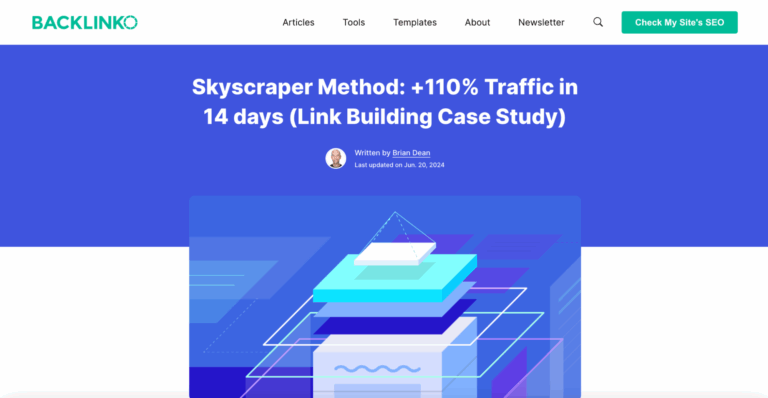
1. Backlinko: Traffic increased 110% with Skyscraper Technique
(Image: Backlinko case study)
Backlinko maintains it saw search engine traffic increase by 110% in 14 days using the Skyscraper Technique. The technique popularized by Backlinko involves three steps:
- Content research
- Creating better content
- Outreach
The case study explains how creating “linkable” assets increases your chances of other sites linking naturally back to yours. As long as the page is high-value, you can leverage those links in perpetuity.
Backlinko also emphasizes how exceptional content that acquires more quality backlinks is:
- Longer
- More current
- Better designed
- More thorough
For the final step, Backlinko recommends reaching out to prospects already linking to similar content. The site you want a link from should already publish content relevant to your industry.
Out of 160 emails Backlino sent to prospects, it gathered 17 quality backlinks — an 11% success rate.
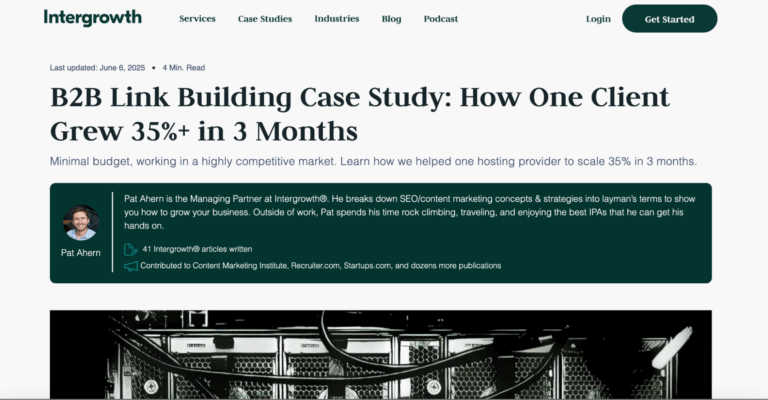
2. Intergrowth: New backlinks led to 55% increase in traffic
(Image: Intergrowth case study)
In this case study, Intergrowth helps a hosting provider client see a 35% increase in growth in just three months.
Here’s how they did it.
Intergrowth established a good SEO foundation and created premium, high-quality, long-form content that other site owners couldn’t help but link to. Then, Intergrowth began link acquisition using tools like Semrush and Ahrefs to identify high-quality opportunities.
After reaching out to around 1,000 bloggers, the hosting client received 43 quality backlinks from 15 referring domains.
The result? A 55% increase in organic traffic.
3. LinkDoctor: 452% increase in organic traffic after link building outreach
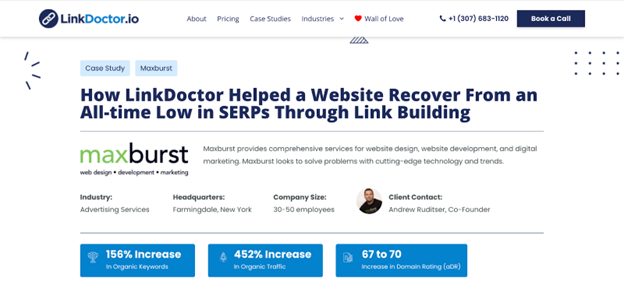
LinkDoctor helped website design company Maxburst overcome its all-time low SERP status.
The brand, which suffered low visibility, had a goal of getting more genuine leads while ranking for more relevant keywords.
After performing a site audit, LinkDoctor suggested content updates, improving content score, being more active on social media, and implementing a better link-building strategy.
Through outreach and active involvement in updating content, Maxburst saw a 156% increase in organic keywords and 452% increase in organic traffic.
eThink: Increased site traffic by 205%
eThink, a leading provider of open-source learning management, needed an agency partner to elevate its SEO strategy after a previous partnership fell short.
HawkSEM stepped in to overhaul their site’s technical and on-page SEO, fixing hundreds of broken links and missing titles, publishing new blog posts, and creating 17 pillar pages.
Then, we audited existing content and secured high-quality backlinks. The results?
- 205% increase in site traffic
- 74% more first-page keyword rankings
- 3X the number of deals generated
How to build backlinks that work: 14 steps
To help you acquire backlinks that make a big impact on your rankings, here are our top expert tips:
- Create valuable content
- Guest blog
- Use influencer outreach
- Create and share informative infographics
- Find broken links
- Engage on social media
- Conduct competitor analyses
- Leverage local partnerships
- Produce research-based content
- Publish press releases
- Use pitching tools
- Build relationships
- Provide testimonials
- Monitor your backlink profile
1. Create valuable content
The foundation of a good backlink strategy, as many experts will tell you, is having excellent content.
“We’ve found that building relationships with industry leaders and collaborating on quality content increases our backlink ranking,” says Diana Zheng, Head of Marketing at Stallion Express.
“Furthermore, producing shareable, quality content positions us as a leader in our industry, which naturally attracts quality backlinks.”
Further reading: Quality Content: 11 Dos and Don’ts From the Pros (+ Free Checklist)
2. Guest blog
Guest blogging is the strategy of writing a blog for another website related to your own. This can help you reach a new audience and earn credibility while earning backlinks.
Use Google search to identify opportunities relevant to your brand with phrases like:
- “Write for us” + [your industry]
- “Contribute to” + [your industry]
- “Submit article” + [your industry]
- “Guest post” + [your industry]
3. Use influencer outreach
Influencer marketing is the strategy of collaborating with an influential person to promote your product or service, offering a wider reach and valuable backlinks to your site.
There are several types of influencers, including:
- Mega influencers: More than one million followers
- Macro influencers: Between 100,00 and one million followers
- Micro influencers: Between 10,000 and 100,000 followers
- Nano influencers: Between 1,000 and 10,000 followers
- Social media influencers: Active on Instagram, Facebook, Twitter, TikTok, LinkedIn, or YouTube
- Podcast influencers: Can influence their listeners through discussions, interviews, and storytelling
- Gaming influencers: Amass large followings on Twitch or YouTube gaming
Further reading: Influencer Marketing: How to Do It Right (+ Pitfalls to Avoid)
4. Create and share informative infographics
Infographics are graphics that combine data, text, and design elements to communicate information in an appealing and clear format.
Interesting and valuable infographics are more likely to be shared across social media and other websites, potentially earning you a number of backlinks.
5. Find broken links
As you research backlink prospects, look for broken links in their existing content. When you find one, offer your content as a relevant, high-quality replacement and briefly highlight why it’s a better fit.
Being transparent and helpful goes a long way in building strong relationships with site owners.
6. Engage on social media
Promoting your content on social media platforms can increase the likelihood of getting backlinks. Share content on social media platforms where your audience is most active, and be sure to engage with comments.
7. Conduct competitor analyses
Tools like Semrush offer link-building tools that allow you to run a full analysis of your backlink profiles, as well as your competitors’. Some tools help investigate gaps in competitors’ current backlink profiles, which helps you decide which opportunities to go after.
Through these analyses, you’ll also see which referring domains have the strongest authority. This data can help you find backlink opportunities that are comparable or better.
8. Leverage local partnerships
If you’re a local business, reach out to other local businesses about exchanging links to each other’s websites. Tourist sites are a great example of this.
Local businesses can link to the tourist site’s web pages for more info, and the tourist site can host an index of all the local businesses — including yours.
9. Produce research-based content
Many marketers search for data to support their content. Producing content with original research, surveys, and reports can be valuable for other sites looking for similar information.
For example, if your website is about improving children’s education, publish a piece of content with statistics on current literacy rates and its accompanying issues and solutions. If other sites are searching for similar statistics and your content is written well, they may link to you.
10. Publish press releases
If you’re an IT company that releases new product features and updates, you’re probably publishing press releases left and right.
These major announcements can lead to backlinks from reputable news sites and industry blogs eager to share your news and updates.
Press releases work for large and small businesses, and there are sites like Newswire that help craft them effectively.
11. Use pitching tools
Pitching tools are platforms that help sources and publishers connect.
Find publications and blogs in need of expert quotes that offer backlinks in return.
Some pitching tools include:
12. Build relationships
Sometimes, casually networking with other bloggers, journalists, and industry leaders can lead to more backlinks. You can find them on LinkedIn, through online forums and discussion boards, or at in-person events.
Even if you build a relationship with someone without the intention of acquiring backlinks, those connections will see you as a valuable resource they feel inclined to link to later on.
13. Provide testimonials
Being part of a case study or offering a testimonial for a product you use can generate a backlink. For example, let’s say you have a travel blog and you have an incredible backpack you take everywhere with you.
Reach out to the brand’s website and pitch a testimonial about how this backpack revolutionizes your travel experience. Be sure they link back to your website and offer to link back to theirs in exchange.
14. Monitor your backlink profile
In Semrush and Ahrefs, you can regularly monitor your backlink profiles to see how healthy they are.
There, you can gather reports about overall backlink health and see which backlinks need to be removed or disavowed.
Do everything you can to resolve the backlink issue before resorting to removing or disavowing.
Good backlinks vs. bad backlinks
“Not all backlink building is created equal,” says Zheng. “There are risks associated with backlink building, such as falling prey to black-hat techniques or prioritizing quantity over quality.”
Here’s a breakdown of the differences between good backlinks and bad backlinks:
Good backlinks
A strong backlink portfolio has the following key features:
- Relevance: High-quality websites related to your content or industry.
- Authority: Websites with high domain authority are trusted sources in their field.
- Organic nature: The best backlinks are earned without asking for them. This is possible through high-quality content that is valuable to other sites’ audiences.
- Diversity: Your backlink profile should have various domains. This indicates a natural link-building process.
- Contextual linking: Backlinks that fit naturally into content provide value and context to the user and don’t feel spammy.
- Follow links: Nofollow links don’t directly boost your site’s domain rank. Dofollow links pass more authority and are generally more beneficial for SEO.
Bad backlinks
Bad backlinks can negatively impact your website and tank your ranking.
Here are the types of backlinks to avoid:
- Irrelevant sources: If the link is unrelated to the content it’s linking to, it signals to search engines that the incoming links aren’t defined by content quality.
- Low-quality or spammy sites: Toxic backlinks from low-quality, spammy, or penalized websites can hurt your rankings and credibility.
- Paid links: Penalties can arise from purchasing backlinks because it goes against Google’s guidelines.
- Overly-optimized anchor text: Anchor text with excessive keyword use can often appear manipulative and unnatural to search engine algorithms’ parameters.
- Link farms and schemes: Google penalizes websites using link farms or link schemes, which are black-hat SEO tactics.
- Rapid acquisition: If you rapidly gain lots of backlinks over a short period of time, it can appear suspicious and inorganic to search engines.
Backlink FAQs
How many backlinks do I need?
There is no specific number of backlinks you need to improve your website’s authority. Instead, you should focus on high-quality, relevant backlinks.
One backlink from an authoritative source is worth more than a dozen lower-quality links — or worse, spammy links that can result in penalties.
Are internal links or external links more important?
Both are important for SEO and offer different benefits. Internal links can help improve the user experience and showcase your topical authority.
External links also showcase your credibility by other websites essentially vouching for you as a cited source.
Do nofollow links count?
Yes, nofollow links count as backlinks; however, they don’t pass traditional “link equity” according to Google’s PageRank. That means nofollow links aren’t as powerful for search engine rankings as a do-follow link.
Additionally, nofollow links drive referral traffic, help build brand visibility, and diversify your link profile, which indirectly enhances your SEO.
Do link-less brand mentions count as backlinks?
No, a link-less brand mention won’t contribute to your backlink portfolio. However, they can still improve brand awareness.
Can I buy backlinks?
You should never buy backlinks. This practice is harmful for several reasons:
- Violates Google’s guidelines
- Risk of penalties
- Low-quality and irrelevant inks
- Costly
- Little to no guarantee of success
- Reputation damage
- Short-term gains with no chance for longevity
The takeaway
The importance of backlinks has never been up for debate — until now.
Despite the Google algorithm’s reduced weight in link building, backlinks are vital to SEO practices.
But remaining ethical with outreach and acquiring natural backlinks remains key. Focus on creating exceptional content that’s authoritative and encourages organic growth all on its own.
For a measured and strategic approach to building your backlink profile, partner with an experienced digital marketing agency like HawkSEM.
Whether you need small business or enterprise SEO, we’ll be your guide through the complex world of link building.
We’ll keep your SEO tactics compliant so you have a higher chance of success. Request a free consultation with our experts today.
This article has been updated and was originally published in May 2024.